
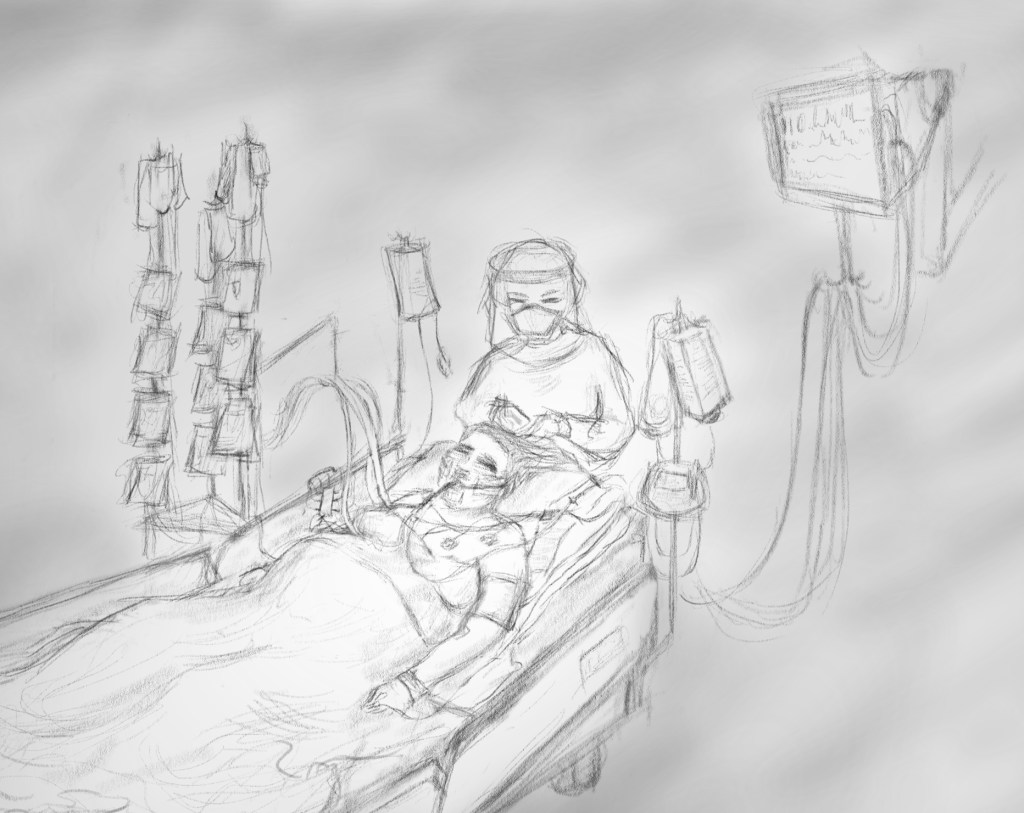
I got a close look at critical care nursing for the first time while working on the prone team at Central Washington Hospital this past winter. This scene – a nurse washing, combing, and braiding the hair of a patient who had been sedated, paralyzed, and ventilated for two weeks and would die only a short time later – was something I witnessed on one of my very first shifts, and I will never forget it. It’s what I picture when I think about the heart of the nursing profession and the reason I’m so proud to be a part of it.
I’m here because I think human suffering in any form is the greatest evil we allow to persist in the world. But human suffering is a really big, really complicated problem to solve. Per the health belief model, one of the primary barriers to action is an assumption that effort is futile, that the problem is too big or complex for one change to make a difference. As nurses we spend every day combating suffering caused by intractable problems like health disparities from social inequity, the complexity of our healthcare system, and barriers to accessing care, such as cost or geographic region or health literacy. And critical care especially is a field of sad endings.
Fighting suffering in a setting of so much futility means finding value in effort regardless of outcome and maintaining a “pessimism of the intellect and optimism of the will,” to quote Dr. Jim Kim in Bending the Arc. It requires humility and stubbornness and a conscious awareness of the traps of victory narratives – anger, burnout, arrogance, and despair. And it means caring for the humanity of patients as much as we care for their lives – and sometimes understanding that one must give way to the other, in the end.
A tension exists in medicine between “care” and “cure,” and in this scene we see the power of nursing to bridge that gap. You have my favorite witchy bits of medicine – the outsourcing of bodily functions to miracle machines and medications, the management of which demands critical thinking and extensive education and training – but we also see the heart of medicine: the way nurses care for the human within the body by prioritizing comfort, identity, and dignity, even in the setting of immense complexity and overwhelming futility.
Nursing is deeply anonymous and humble work that requires intellect and skill, and humanity above all. It brings to mind a quote by an organizer named James S Kumen: “I am not a leader, you understand. But leaders cannot seize and occupy buildings. It takes great numbers of people to do that. I am one of those great numbers. What follows is the chronicle of a single revolutionary digit.”
References
Kunen, J. S., & Kunen, J. S. (1969). The strawberry statement: Notes of a college revolutionary (Vol. 34). New York: Random House.
 the crannied wall